Coco-Glucoside vs. Sulfates: What’s Really Cleaning Your Skin
Every foaming cleanser needs a surfactant — a molecule that bridges oil and water, allowing sebum, makeup, and environmental residue to be lifted from the skin and rinsed away. The surfactant is the functional core of any cleanser. Everything else in the formula is built around what it can and cannot do.
The industry default for decades has been sulfate-based surfactants — sodium lauryl sulfate (SLS) and its close relative sodium laureth sulfate (SLES). They are inexpensive, highly effective at removing oil, and produce the dense lather most consumers read as a sign that a cleanser is working. They are also among the most well-documented sources of skin barrier disruption in cosmetic chemistry. The fact that both things are true simultaneously — effective and damaging — is the central tension in cleanser formulation that most brands have chosen to resolve in favor of cost and consumer expectation rather than skin health.
Coco-glucoside represents a different resolution of that tension. Understanding why requires looking at what surfactants actually do at the skin level — not just in the formula.
How surfactants work — and where sulfates go wrong
Surfactant molecules have two ends: one that attracts water (hydrophilic) and one that attracts oil (lipophilic). When applied to wet skin, they orient themselves around oil and sebum particles, encapsulating them in micelles that water can then carry away. This is the mechanism all surfactants share. The differences between them lie in how aggressively they interact with the skin’s own lipid structures in the process.
Three properties define how a surfactant behaves on skin — and where sulfates fail on all three:
Molecular size and penetration depth.
Sodium lauryl sulfate has a small molecular size and high charge density — properties that make it an aggressive cleanser but also mean it penetrates the skin barrier rather than acting at the surface. It does not distinguish between the sebum it is designed to remove and the intercellular lipids of the stratum corneum it should leave intact. The result is barrier disruption at the structural level, not just surface cleansing.
Protein interaction and inflammation.
SLS denatures epidermal proteins and triggers an inflammatory response that persists well after rinsing. This is not a temporary flush from hot water — it is a low-grade inflammatory signal driven by the surfactant itself. For anyone using actives like retinol or glycolic acid, that pre-existing inflammation compounds the irritation load those ingredients create, reducing tolerance and increasing the likelihood of visible reactivity over time.
Cumulative barrier cost at daily frequency.
A single wash with an SLS-based cleanser produces measurable transepidermal water loss elevation — a direct indicator of barrier disruption. Applied twice daily, every day, that disruption compounds. The skin that feels perpetually dry regardless of moisturizer, or that has become reactive to products it previously tolerated, is often experiencing the accumulated cost of a surfactant that has been degrading its structural integrity one wash at a time.
What coco-glucoside is and how it differs
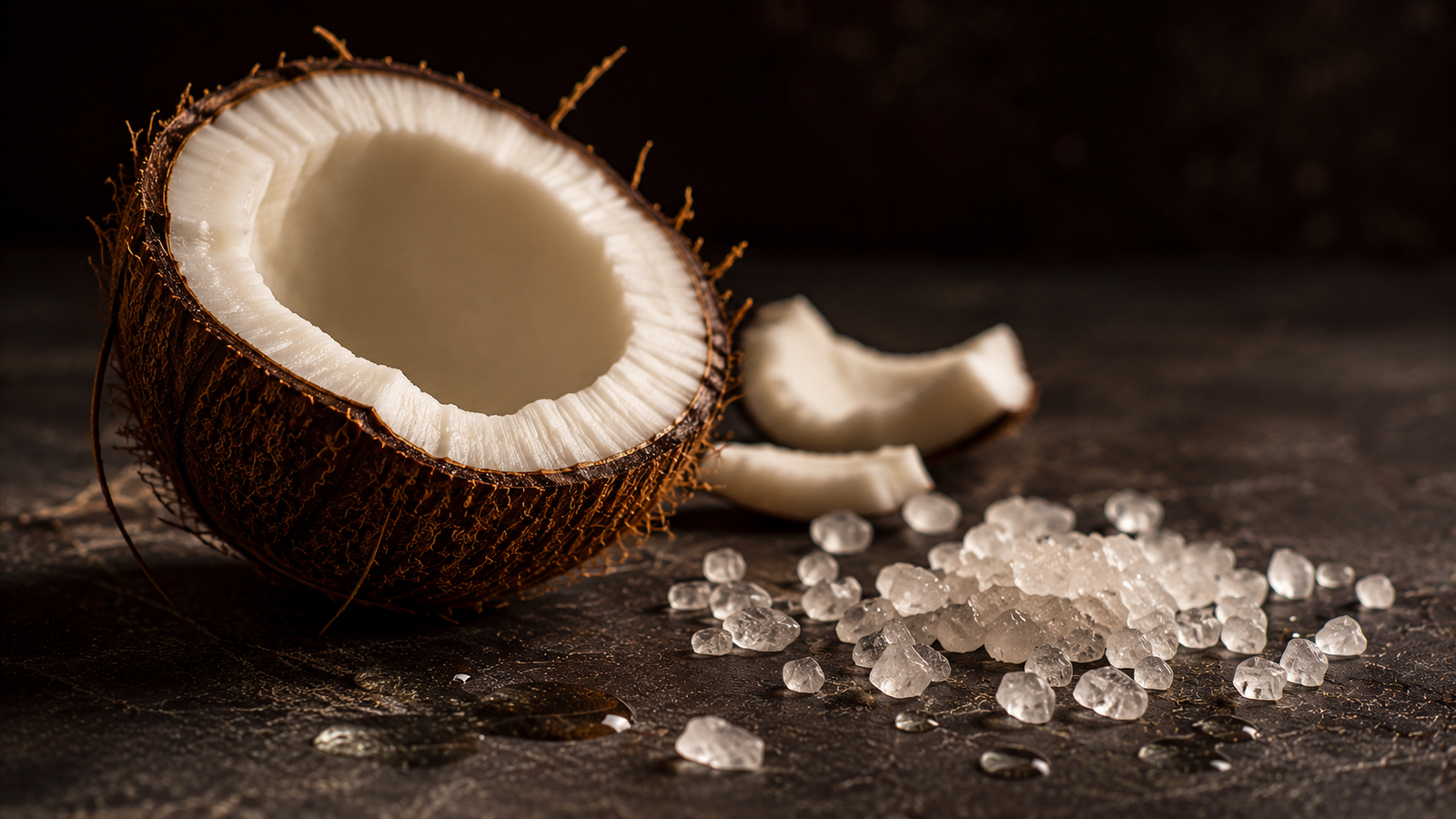
Coco-glucoside is a non-ionic surfactant derived from coconut fatty alcohols and glucose — typically from corn or other plant sources. It is classified as an alkyl polyglucoside (APG), a family of surfactants recognized as among the mildest available for cosmetic use. Its non-ionic charge means it does not interact with the skin’s proteins or lipids in the same disruptive manner as anionic sulfates. It cleanses through the same micellar mechanism, but without the aggressive penetration and protein denaturation associated with SLS.
Clinical comparative studies consistently show that alkyl polyglucosides produce significantly less transepidermal water loss elevation than sulfate-based surfactants at equivalent cleansing concentrations. Lower TEWL elevation means the barrier is less compromised after each wash. At daily use frequency, that difference compounds into a meaningfully different skin condition over weeks and months.
Coco-glucoside also has a favorable skin compatibility profile across all skin types including sensitive and atopic-prone skin, where sulfate surfactants reliably cause flare reactions. It is biodegradable, produced from renewable plant sources, and does not require ethoxylation — eliminating the manufacturing byproduct concerns associated with SLES.
The lather question
The most common objection to sulfate-free cleansers is lather — or the perceived absence of it. Coco-glucoside produces less dense foam than SLS. This is not a performance deficiency. It is a cosmetic difference with no bearing on cleansing efficacy. The relationship between foam density and cleaning performance is one of the most persistent and consequential myths in skincare consumer behavior.
Cleansing efficacy is determined by surfactant-oil interaction — by the ability of the formula to encapsulate and remove sebum and impurities. Foam is a byproduct of surfactant agitation in water. It is not the mechanism of cleansing. A formula with modest lather that removes sebum without disrupting the barrier is a more effective cleanser — by any measure that accounts for skin outcome — than a high-lather formula that cleans thoroughly and leaves the barrier compromised.
The expectation of dense lather was built by decades of sulfate-dominant formulation. It is a conditioned response, not a functional requirement — and one worth examining if the goal is skin that improves over time rather than skin that feels immediately clean and progressively more reactive.
Why the surfactant choice defines the whole formula
The surfactant is not one ingredient among many in a cleanser. It is the primary active — the component doing the functional work. Everything built around it either compounds or counteracts its effect on the skin. A formula that pairs a disruptive sulfate surfactant with botanical calming ingredients is not balanced. It is fighting itself — the surfactant creating barrier stress that the botanicals cannot meaningfully offset in a rinse-off product with limited contact time.
Building around a mild surfactant like coco-glucoside changes what the rest of the formula can accomplish. When the surfactant is not the source of barrier disruption, botanical actives like rose water, chamomile, and calendula are not working against a headwind. They are contributing to a formula that is net-positive for skin health at every use — rather than partially compensating for damage the surfactant is simultaneously inflicting.
That is the formulation logic behind Ember’s coconut-derived surfactant system — coco-glucoside as the cleansing base, paired with certified organic botanicals that can function as intended precisely because the surfactant is not undermining them. No sulfates is not a marketing claim. It is a formulation decision with a specific consequence: the cleanser does not make the barrier problem worse.
What to look for on the label
Reading a cleanser label for surfactant type is straightforward once you know what to look for. Sulfate surfactants appear as sodium lauryl sulfate, sodium laureth sulfate, ammonium lauryl sulfate, or ammonium laureth sulfate — all near the top of the INCI list, reflecting their high concentration as the primary cleansing agent.
Alkyl polyglucosides appear as coco-glucoside, decyl glucoside, or lauryl glucoside. Their position near the top of a cleanser’s INCI list indicates they are the primary surfactant system — not a token mild addition to soften a sulfate-dominant base. A cleanser that lists coco-glucoside as its first or second ingredient after water has made a structural formulation choice in favor of barrier compatibility.
In Ember, the surfactant system is coconut-derived and sulfate-free — decided at the formulation stage, before the botanicals, before the certifications, before anything else — because everything that follows depends on the surfactant not being the source of the problem it is supposed to solve.
The cleanser that strips your barrier twice a day is not a neutral step. It is the most repeated source of skin stress in your entire routine.
Ember — Botanical Foaming Cleanser
Coconut-derived coco-glucoside. Zero sulfates. Certified organic botanicals.
Shop EmberREXODIA — Precision skincare. No compromise.