Rose Flower Water: The Ancient Hydrator Modern Cleansers Forgot
Rose flower water — distilled from Rosa damascena petals — is one of the most effective hydrating and soothing ingredients ever used in skincare. It is also one of the most consistently absent from modern foaming cleansers, replaced by cheaper synthetic alternatives that clean efficiently and disrupt the skin barrier in the process.
Its history spans Persian, Ottoman, and South Asian beauty traditions, where it was used not as a fragrance but as a functional skin treatment — prized for its ability to calm inflammation, restore pH balance, and leave the complexion hydrated rather than reactive. That track record didn’t disappear because something better came along. It disappeared because something cheaper did.
This isn’t an argument for nostalgia. It’s a case for paying attention to what was working before the industry decided cost-per-unit mattered more than what happens to your skin after you rinse.
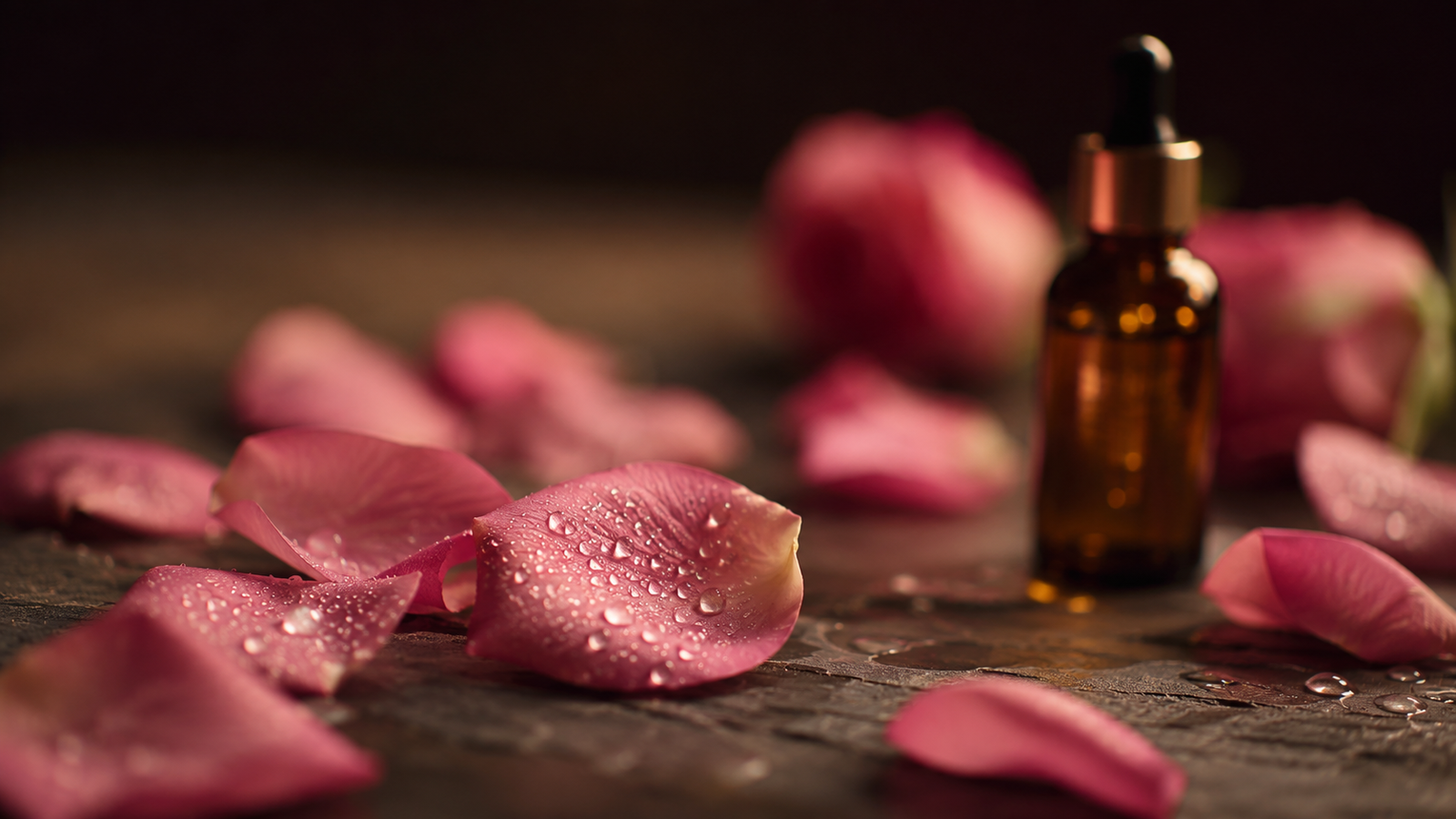
What rose flower water actually does for skin
Rosa damascena distillate is produced through steam distillation of rose petals — a process that captures the plant’s bioactive compounds in a stable, water-soluble form. The result is a mildly acidic liquid rich in flavonoids, tannins, and antioxidant compounds. It is not a perfuming agent. It is an active ingredient that happens to smell pleasant as a secondary characteristic.
Three properties make it particularly valuable in a cleanser:
It supports the skin’s natural pH.
The skin’s acid mantle sits between pH 4.5 and 5.5. Most commercial cleansers sit at pH 7–9 — alkaline enough to strip that mantle with every wash. The result is temporary but cumulative: repeated disruption leads to chronic sensitivity, increased bacterial vulnerability, and accelerated moisture loss. Rose water’s naturally lower pH allows cleansing to happen without pushing the skin outside its functional range.
It reduces inflammation at the first step.
The flavonoids in Rosa damascena have documented anti-inflammatory activity. For anyone using retinol, vitamin C, glycolic acid, or other actives, inflammation management at the cleansing stage is not a luxury — it’s foundational. A botanical foaming cleanser formulated with rose water reduces baseline reactivity before serums and treatments are applied, which directly affects how those actives perform and how well the skin tolerates them over time.
It delivers hydration during cleansing, not after.
Standard foaming formulas treat hydration as a corrective step — something applied after the cleanser has stripped the skin. Rose water integrated into the cleanse itself means skin is not left in a moisture deficit between steps. It changes the cleanser from a subtraction to a net-neutral, or better.
Why modern cleansers replaced it — and what that decision actually cost
Sodium lauryl sulfate and its derivatives dominate commercial cleanser formulation for one reason: they are inexpensive, easy to stabilize, and produce the thick lather that consumers have been conditioned to read as efficacy. The association between foam and cleanliness is a marketing legacy, not a scientific one. Dense lather does not correlate with better cleansing. It correlates with higher surfactant concentration — and higher surfactant concentration correlates directly with greater barrier disruption.
Rose water requires more complex formulation to stabilize at effective concentrations. It is significantly more expensive to source from authenticated, traceable origins. It does not produce the lather density that mass-market consumers expect. These are manufacturing and marketing problems, not skin problems — and brands operating at scale prioritize solving the former.
The result is that most people using a daily foaming cleanser are using a formula optimized for shelf appeal and unit cost, not for what their skin needs twice a day, every day. A cleanser formulated around certified organic rose water is the product of a different set of priorities — one where the primary constraint is skin outcome, not manufacturing convenience.
The barrier feedback loop nobody addresses
There is a compounding problem embedded in most skincare routines that rarely gets examined: the cleanser strips the barrier, the barrier becomes reactive and dry, additional products are purchased to manage that reactivity, those products create their own stress, and the cleanser continues stripping twice a day as the baseline. The cleanser is almost never identified as the source because it rinses away. It feels like a neutral step.
But what rinses away is not just makeup and environmental residue. It’s ceramides, natural moisturizing factors, and the acid mantle that took the skin hours to rebuild since the last wash. A cleanser that disrupts these structures every morning and every night creates a cumulative deficit — one that no serum or moisturizer fully corrects, because the disruption is continuous and the repair is intermittent.
Rose flower water’s function in a well-formulated cleanser is structural. It is not there for texture or scent. It is there to help the formula remove what needs removing without becoming another source of barrier stress in a routine that already asks a great deal of the skin.
What this means for your skincare routine
If your skin feels tight, dry, or reactive immediately after cleansing — even with a formula marketed as gentle — that sensation is diagnostic. Tightness after cleansing is not clean skin. It is skin that has had something taken from it that should have stayed. The routine downstream from that moment — the toner, the serum, the moisturizer — is partially compensating for damage inflicted at step one.
Correcting that starts at the cleanser. A formula built around rose flower water and complementary botanical actives changes the cleansing step from a deficit to a foundation — skin arrives at the rest of the routine calm, hydrated, and ready to absorb rather than depleted and reactive. Serums perform better. Actives are tolerated more predictably. The skin requires fewer corrective interventions overall because the first step is not creating the problem the rest of the routine is trying to solve.
That is the formulation rationale behind Ember — a botanical foaming cleanser built on a certified organic rose water base, with chamomile and calendula extracts to reinforce the barrier rather than erode it. Not a positioning choice. A formulation one.
The ingredient was never outdated. It was just inconvenient for an industry built on speed.
Ember — Botanical Foaming Cleanser
Certified organic rose water. Chamomile. Calendula. No sulfates.
Shop EmberREXODIA — Precision skincare. No compromise.